
Manage your rentals and your books from one place.
You're probably running this across a spreadsheet, QuickBooks, a photo folder, and your phone right now. Controlio replaces all four with one ledger that everything posts to — every dollar traces back to a receipt, and every number traces back to the ledger.
Four tools. Zero system.
Nothing you use today was built for a landlord's books. Each one covers a corner and leaves the rest to you.
| Your current world | Upgraded with Controlio | |
|---|---|---|
| The spreadsheet | Sort a column wrong and the numbers stop meaning anything. No audit trail, no receipts attached, and it falls apart once you add a third building. | A real rent roll, where every payment is tied to a unit, a lease, and a tenant ledger. |
| QuickBooks | Built for every small business, which means built for none of them. No concept of a unit or a lease — your accountant translates it twice a year, and the rest of the time you're guessing. | Double-entry books shaped like a rental portfolio, with properties, units, tenants, and leases. |
| The photo folder | Thousands of photos named IMG_4829, with the furnace receipt from two years ago somewhere in the middle of them. | Every receipt is captured, matched to the expense, and attached to the unit on the day it happens. |
| Your phone | Maintenance requests live in your texts, rent reminders live in your head, and the plumber's number is nowhere in particular. | One record per unit covering the lease, the ledger, and the documents, so nothing important lives only in your head. |
The money loop, closed
Four steps, every month, in one place. This is the workflow the whole product is built around — the one your current stack breaks.
1. Collect
Rent and every other tenancy charge post to the ledger automatically. The rent roll shows who's paid, who's late, and by how many days.
2. Capture
Snap the receipt at the counter. It's read, categorized, filed to the unit, and matched to the bank transaction when it lands.
3. Reconcile
One review queue with AI suggestions and your own rules, because the system knows which building a vendor belongs to.
4. Report
Every figure traces to a receipt. Pull the standard report set, by property or across the portfolio, ready for your accountant.
One ledger that everything posts to. The rent roll, the lease, and the year-end reports are all views of the same record — which is what a system of record is supposed to be.
Real books, not expense tagging
A spreadsheet has no audit trail. QuickBooks doesn't know what a building is — you'd need a class scheme you maintain by hand just to tell what one property earned. This is double-entry accounting that already knows what a unit and a lease are, where every line on your T776 or T2 traces back to the receipt behind it.
Own properties in more than one corporation? They reconcile to each other automatically.
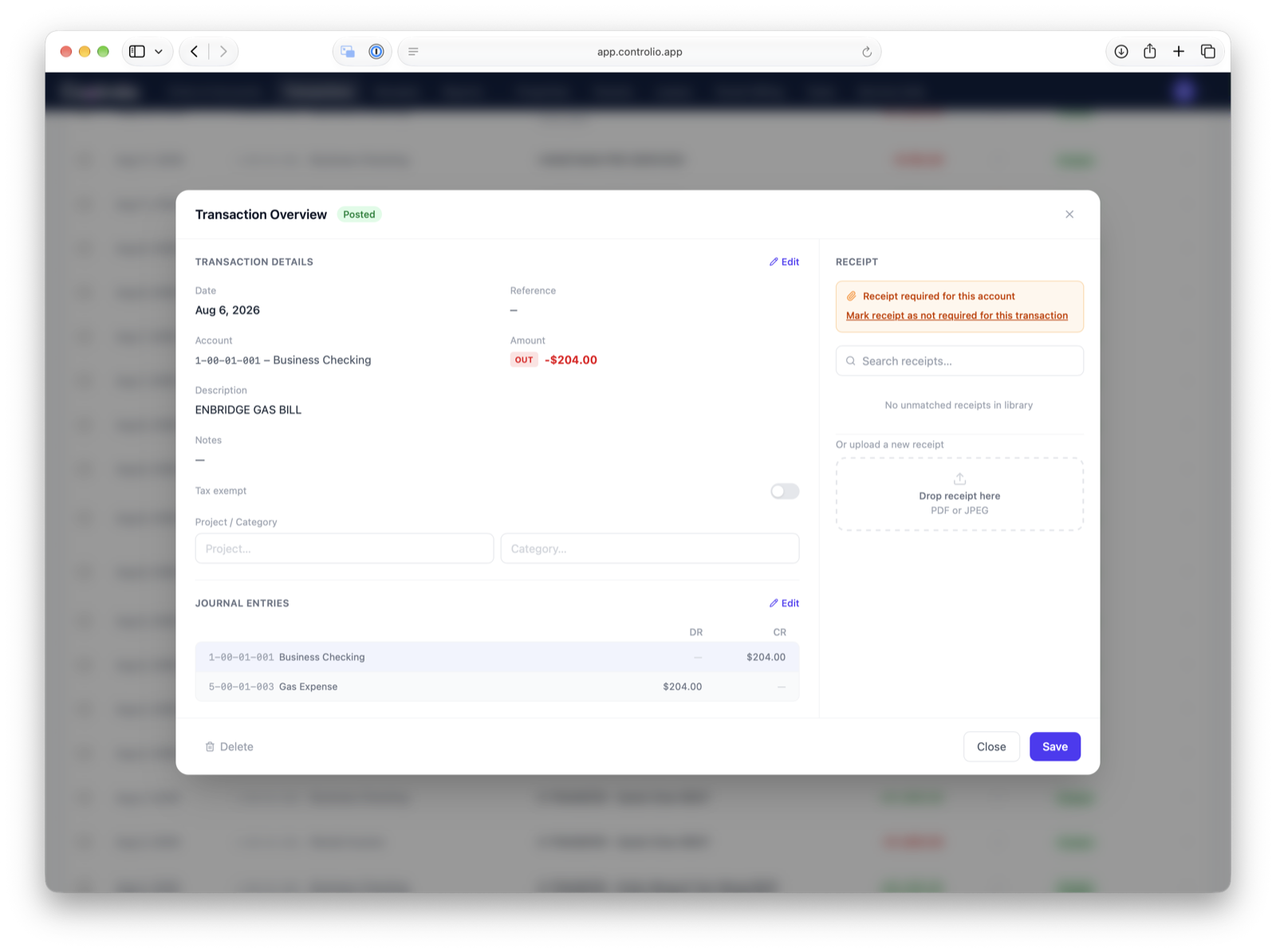
Screen applicants in 30 seconds, not 20 minutes
You already know the read at the end is solid — the pain is the 20 minutes of manual document review to get there, repeated for every applicant. Drag in a candidate's documents and get a consistent screening report with key flags immediately.
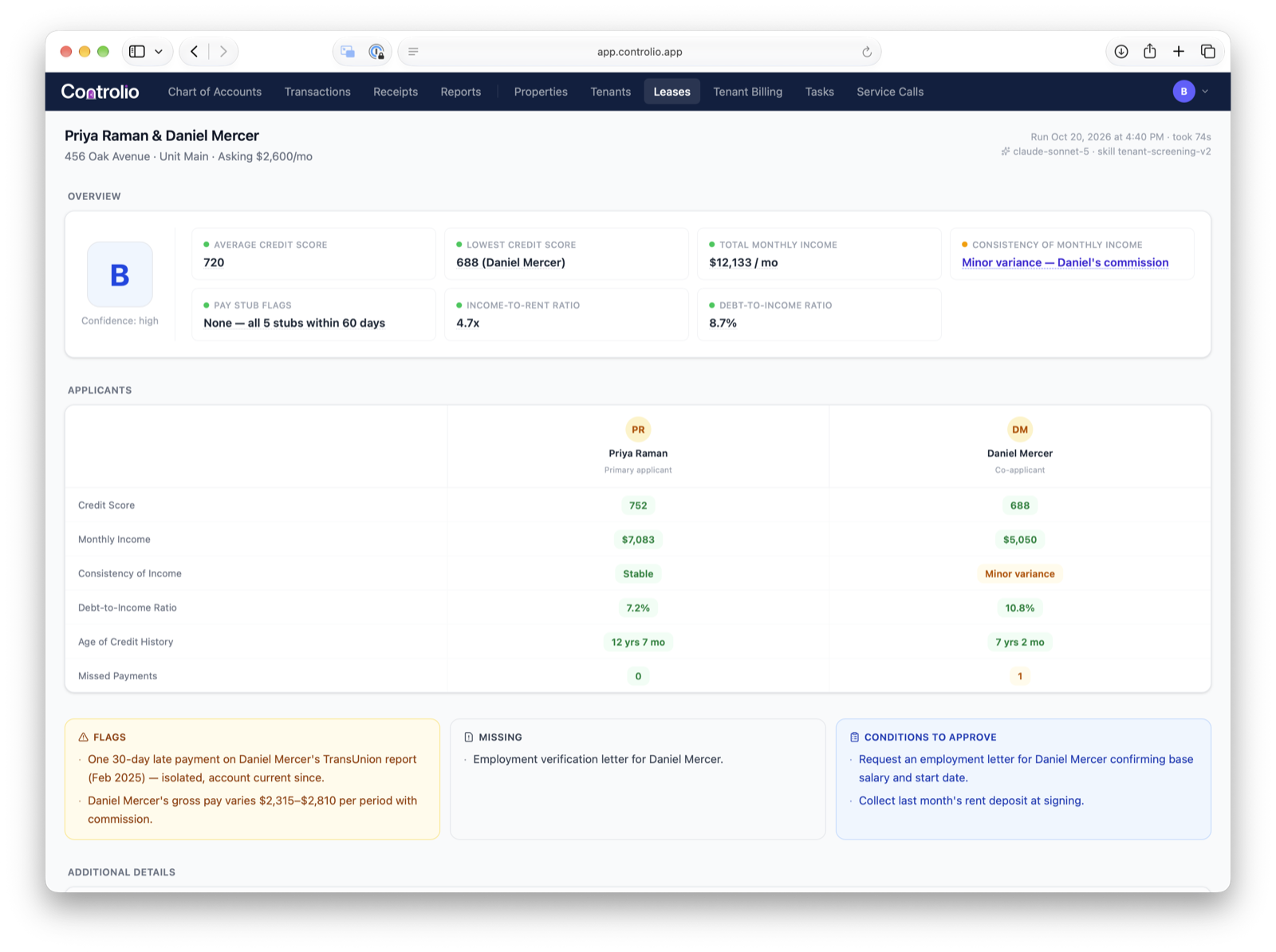
Rent, utilities, and shared costs. Billed and tracked.
If you're splitting internet or utilities across units in a multiplex, you're probably doing it by hand every month — and when a month gets skipped, that revenue doesn't come back. Pass-through charges become real receivables in the same ledger as rent, so a missed bill is a caught bill, not a lost one.
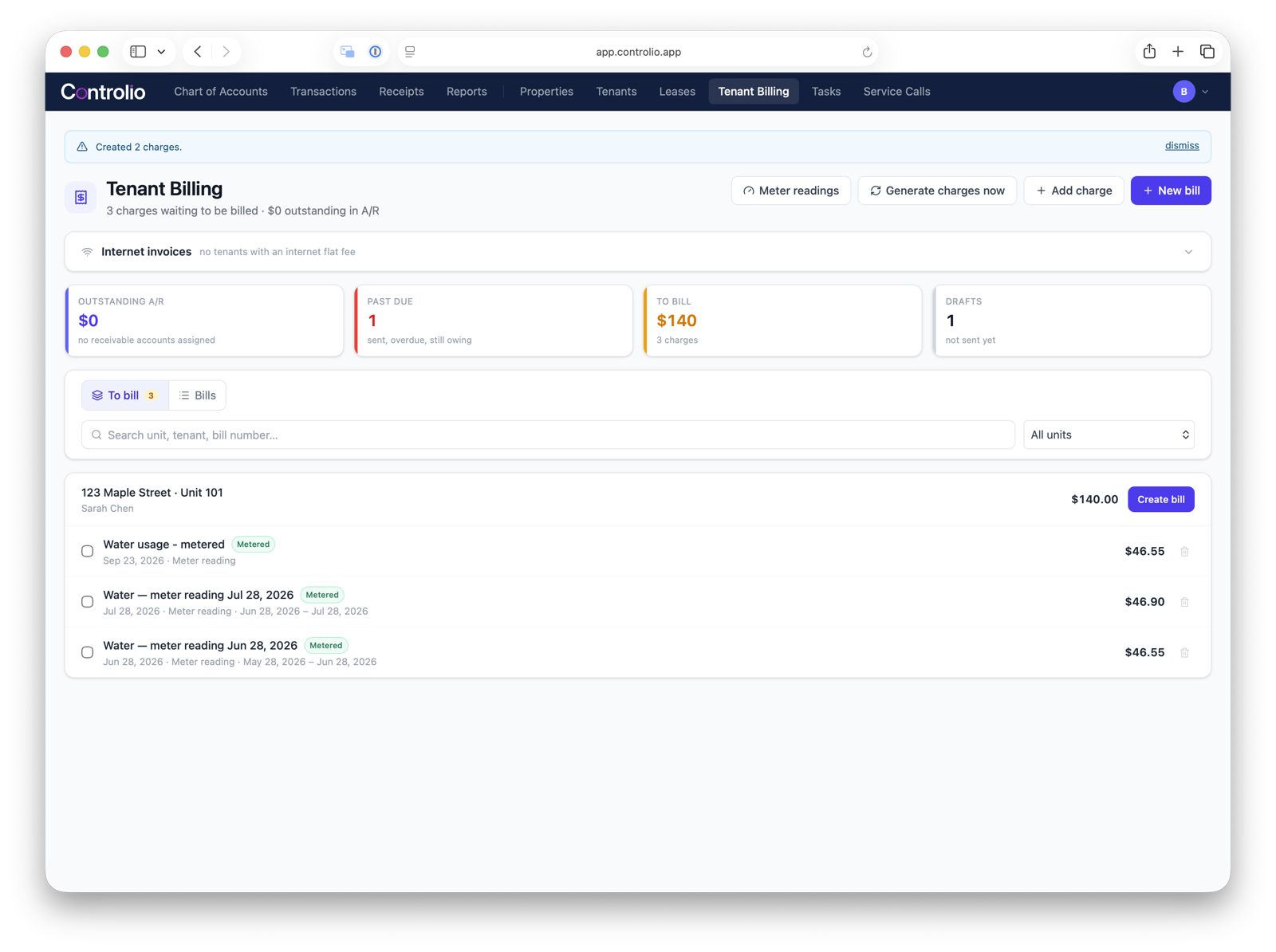
Built for Canadian 🇨🇦 property owners
Most property software was built for the US market and adapted for Canada as an afterthought. This was built for the Canadian tax model from the start.
Real double-entry
A trial balance and a year-end close, not expense tagging with a category dropdown.
Multi-entity reconciliation
Hold properties across corporations. They reconcile to each other instead of drifting apart.
CAD · T776 · T2 · GST
Pricing, reporting, and the tax model built for how Canadian owner-operators actually file.
Onboarding made easy. In just 30 minutes.
You send what you have. We do the configuration. One call, and you're running.
- Send your recordsLeases, bank history, whatever you have. We take it from there.
- We configure everythingProperties, units, chart of accounts, recurring charges. Built from your data, not a blank template.
- One complimentary call, then you're liveWalk through it together, adjust what needs adjusting, and start with your actual numbers already in the system.
Your books stay yours.
Controlio holds your records; it doesn't hold them hostage. What you put in, you can take out.
Encrypted, never sold
Your data is encrypted and never sold to anyone, for any reason.
Export anytime
Export everything, any time, in formats your accountant already uses.
Asked, answered.
Are you a property manager?
No, and that's deliberate. Controlio is built for owner-operators managing their own buildings. Fee-based managers need per-client scoping, client reporting, and trust accounting we don't do. We'd rather be the right tool for landlords than the wrong tool for everyone.
Is Controlio replacing my accountant?
No — it's trying to make their bill smaller. Controlio keeps the books your accountant wishes you kept, then hands them reports where every line traces to a receipt. An accountant works from what you give them, so give them this.
Do you collect rent for me?
No. Controlio tracks every tenancy transaction — charges, payments, balances — but it doesn't move money. Your tenants keep paying the way they pay now; the record is what we own.
I already use QuickBooks.
Capability — QuickBooks can't tell you what one building earned without a class scheme you maintain by hand. It has no concept of a unit or a tenant.
Cost — Priced as general business software for every kind of business, not sized around a rental portfolio.
Interface — That generality is why it's complex. Every field you don't need is still in your way. This only has to do one job.
I could build this in Excel with Claude.
For the accounting side — genuinely, yes. A spreadsheet with an AI copilot can approximate a ledger. What it can't do is hold the property side: a unit, a lease, a tenant, a service history, and the documents behind all of it, connected as one record. A spreadsheet is a grid no matter how good the AI layer is. The property record, you're describing to the AI fresh every time.
Do you generate Ontario forms?
Lease agreements and the Ontario Standard Lease are live now, along with N4 notices. More RTA forms, including N1 and N2, are on the way — built on the lease and ledger records Controlio already holds.
What happens to my data if I leave?
It leaves with you. Export everything, any time, in formats your accountant already uses. Your data is encrypted, never sold, and never held hostage.
I've only got a few units.
The work doesn't scale with doors, it scales with months. Six units for a year is the same shoebox as twenty for a quarter.
How long does setup take?
Getting everything in cleanly is real work. We take as much of that off your plate as we can — you send what you've got, we configure before the call, and you're not building a chart of accounts from scratch.
Let's get you in control of your properties.
Send your leases and bank history. We'll configure everything and walk you through it on one free call.
Get started for freeNo commitment. Free during beta. We configure everything before the call.